

Litigation Process
Most people who contact us about a professional negligence claim are braced for a court battle. What often surprises them is that a significant number of claims — including many involving substantial losses — are resolved through mediation, long before a judge ever hears a word of evidence.
That’s not a compromise. It’s a legitimate and well-structured process, and understanding how it works can help you approach it with confidence rather than anxiety.
The basics
Mediation is a structured negotiation process in which both parties to a dispute meet with an independent, accredited mediator. The mediator doesn’t decide who wins. Their job is to help both sides communicate, identify common ground, and explore whether a negotiated outcome is possible.
Everything discussed in mediation is confidential. Any settlement reached requires the agreement of both parties — you cannot be forced to accept an outcome you don’t want.
Timing
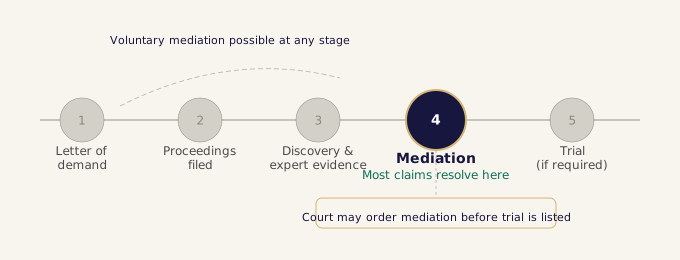
There’s no fixed point in the litigation timeline where mediation must occur. It can happen at several stages:
Courts in all Australian jurisdictions have the power to refer matters to mediation. In New South Wales, for example, s 26 of the Civil Procedure Act 2005 (NSW) expressly empowers courts to refer proceedings to mediation. Equivalent provisions exist across other states and territories.
Professional negligence cases are particularly suited to mediation because the other side is usually an insurer, not the professional personally. Insurers are commercially motivated to manage their exposure — and that dynamic often makes a negotiated resolution more achievable than it might first appear.
Your rights
This is one of the most common questions we hear, and it deserves a careful answer.
A court can order your matter to mediation. If it does, you are expected to attend and participate in good faith. A party that unreasonably refuses court-ordered mediation may face adverse costs consequences — meaning the court may penalise that party in how it awards legal costs.
However — and this is important — a court cannot compel you to settle. Mediation is about participation, not capitulation. You can attend, engage fully, and walk away without an agreement if the offers put forward don’t reflect the strength of your claim. Your right to proceed to trial remains intact.
Voluntary mediation, by contrast, only happens if both parties agree to it. Neither side can be dragged to the table before proceedings have been ordered.
The process
People often picture mediation as a formal hearing with both sides sitting across a table trading arguments. In practice, it usually looks quite different.
Both parties typically provide the mediator with a brief outline of their position. Your lawyer will have prepared a summary of the claim, the key evidence, and your view of an acceptable range of outcomes.
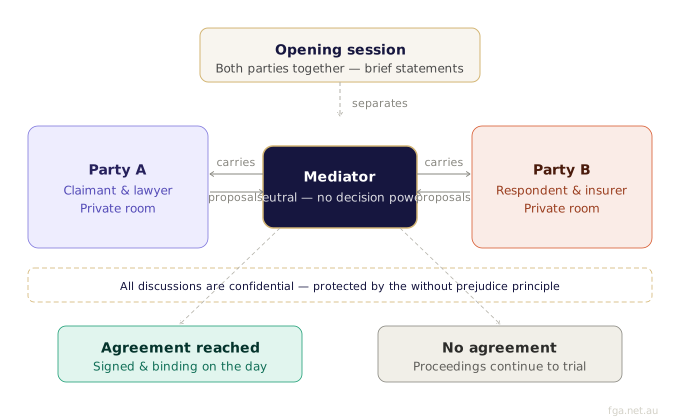
The session usually begins with both sides in the same room. Each party — typically through their lawyer — gives a brief overview of their position. This is less about persuasion and more about making sure everyone understands what the dispute actually involves.
Once opening statements are done, the mediator will usually separate the parties into different rooms and move between them. These private sessions are where the real negotiation happens. The mediator carries proposals between the parties, tests the strengths and weaknesses of each position, and helps both sides understand the risks of not settling.
What is said in mediation is generally protected. The without prejudice principle means that offers and concessions made in mediation cannot ordinarily be used against a party in subsequent court proceedings. This allows both sides to negotiate frankly without fear that an admission will come back to haunt them.
Mediation concludes in one of two ways — either the parties reach a written agreement, which is typically signed on the day and becomes binding, or mediation is declared unsuccessful and the matter returns to the litigation track. A failed mediation is not a defeat. It simply means the case continues.
Mediators in Australia who conduct civil disputes are typically accredited under the National Mediator Accreditation System (NMAS), which sets professional and ethical standards for practising mediators.
Preparation
Going into mediation without preparation is one of the most common mistakes claimants make.

Mediation is most effective when both sides have a realistic picture of the merits. If your expert evidence is not yet in place, you may be negotiating blind. Expert reports — whether from a medical specialist, an independent solicitor, or a financial adviser — help establish what a court would likely find, and that anchors any realistic conversation about settlement value. See our page on expert witnesses in professional negligence for more on how that evidence is prepared.
Your lawyer should be able to give you a frank assessment of what a court might award if the matter proceeded to trial, and what costs would be incurred to get there. A settlement that looks modest in isolation may look very reasonable once those costs are factored in — or it may not.
Mediation can move quickly. Offers are made, rejected, and revised within hours. Having an experienced professional negligence lawyer with you means you’re not making those decisions under pressure, alone, in real time.
If the offer on the table doesn’t reflect the strength of your claim, you are under no obligation to accept it. Walking away from mediation is not a failure — it is your right.
If it doesn’t resolve
Mediation that doesn’t produce an agreement is not the end of the road. The matter simply continues through the litigation process.
After a failed mediation, the court will typically re-list the matter for a directions hearing, where further steps toward trial are set out. The costs of the mediation itself — the mediator’s fees — are usually shared between the parties or dealt with as part of any eventual costs order.
Importantly, a failed mediation does not damage your claim. Nothing said during a confidential mediation session can ordinarily be used against you. Your position going into trial is the same as it was before mediation.
Sometimes, parties make formal settlement offers around the time of mediation that carry costs consequences if unreasonably refused — known as Calderbank offers. Understanding how those offers interact with your litigation strategy is part of what your legal team manages. Our page on settlement negotiations covers that in more detail.
The decision
There’s no universal answer to this question. It depends on the strength of the evidence, the conduct of the other side, the quantum of the claim, and the commercial realities of running a trial.
What we can say is this: mediation, when it works, offers a faster, less expensive, and more private resolution than a contested trial. You retain control over the outcome. You avoid the stress and uncertainty of a hearing. And you resolve the matter on terms both parties have agreed to.
Trial, on the other hand, produces a binding judicial determination. Where the other side is making offers that don’t come close to reflecting the seriousness of what happened — or where liability is genuinely disputed — taking the matter to a hearing is sometimes the right and necessary choice.
The decision belongs to you, made in partnership with a legal team that understands exactly where your claim sits and what the realistic pathway forward looks like.
If your claim is approaching mediation — or if you’re at an earlier stage and want to understand your options before things go further — our team can help.
Common questions
Not automatically, but courts in every Australian state and territory have the power to order mediation once proceedings have commenced. Whether mediation is ordered depends on the nature of the dispute and the court’s assessment of whether it may assist. Voluntary mediation — before or after proceedings — is available to both parties at any time.
No. Mediation requires the consent of both parties to produce a binding outcome. You can participate fully in the process and still decline any offer that doesn’t reflect the merits of your claim. Your right to proceed to trial remains intact regardless of how the mediation goes.
A mediator facilitates negotiation between the parties. They do not give legal advice, assess the merits of either side’s case, or make a binding decision. Their role is to help both parties communicate, identify what they’re actually trying to achieve, and explore whether a mutually acceptable outcome is possible.
The matter continues through the litigation process. A failed mediation is formally noted, and the case returns to the court for further directions. Nothing said during mediation can ordinarily be used against you in subsequent proceedings, so your legal position is unchanged.
Most civil mediation sessions are scheduled for a full day, though some resolve in a few hours and others extend across more than one session depending on the complexity of the claim. The scheduling lead time — from when mediation is agreed or ordered to when it takes place — varies but is commonly four to eight weeks.
You are not legally required to bring a lawyer. But in professional negligence claims — which often involve contested expert evidence, complex damages calculations, and insurance-backed respondents — attending without legal representation puts you at a significant disadvantage. Your lawyer’s job at mediation is to advocate for your interests, advise on any offers in real time, and ensure that any agreement reached is properly documented.
Our goal is to help people in the best way possible. this is a basic principle in every case and cause for success. contact us today for a free consultation.
Sign up to our newsletter