

Australia-wide · No win, no fee · Free case evaluation — speak to us today
Legislation hub
The Australian Consumer Law (ACL), contained in Schedule 2 of the Competition and Consumer Act 2010 (Cth), gives consumers statutory guarantees when they acquire services. When a professional supplies services that fall short — whether because they lacked due care and skill, were unfit for the purpose you made known, or were simply never delivered as promised — the ACL may give you an independent basis for a claim, in addition to or separate from the common law of professional negligence.

Scope of the law
Most people think of the ACL as something you invoke when a product fails or a tradesperson leaves a job half-finished. And while that is true, it reaches much further. Lawyers, financial advisers, accountants, engineers, surveyors, mortgage brokers — anyone who supplies a service in the course of a business is bound by the ACL’s consumer guarantees, provided the service meets the threshold definition of a “consumer acquisition.”
Under the ACL, a person is treated as a consumer if the services cost $100,000 or less. Above that threshold, the person may still qualify as a consumer if the services were acquired for personal, domestic, or household use. For most individual professional negligence claimants, the consumer threshold is not a barrier — it covers the vast majority of situations where a professional is engaged by an individual or a small business.
Importantly, the ACL is federal legislation. It applies uniformly across every state and territory in Australia, administered jointly by the Australian Competition and Consumer Commission (ACCC) and state and territory fair trading offices. Unlike professional negligence law, which varies across jurisdictions through different Civil Liability Acts and limitation regimes, the ACL provides a nationally consistent floor of consumer protection.
Statutory guarantees
Part 3-2 of the ACL sets out a series of consumer guarantees that apply automatically to the supply of services. You cannot contract out of them, and a professional cannot include terms in an engagement letter that exclude them. Three guarantees are particularly relevant to professional services claims.
Due care and skill (s 60)
Services must be rendered with reasonable care and skill. This is the guarantee most claimants rely on, because it mirrors the standard of care requirement in professional negligence — but it arises by statute rather than at common law. A solicitor who misses a critical deadline, a financial adviser who fails to read the product disclosure statement, or an engineer whose calculations contain elementary errors may all breach s 60.
Fitness for purpose (s 61)
If you made known to the professional the particular purpose for which you were engaging them, or the result you were seeking, the services must be reasonably fit for that purpose. This guarantee adds real value where a professional agreed to achieve something specific — for example, a conveyancer engaged to ensure a property transaction completed by a particular date, or an accountant retained to structure an arrangement for a defined tax outcome.
Completion within a reasonable time (s 62)
Where no time for completion was agreed, the services must be supplied within a reasonable time. This guarantee tends to be less central in professional negligence claims but can be relevant where delay itself caused the harm — for instance, a solicitor who failed to progress a matter within any reasonable timeframe, causing a right to expire.
These guarantees exist independently of whatever the professional’s engagement agreement says. A disclaimer in the retainer letter does not extinguish them. An exclusion clause in a financial services agreement cannot remove them. The ACL makes that clear, and Australian courts have consistently upheld it.
Section 18 ACL
Beyond the service guarantees, the ACL contains one of the most powerful provisions in Australian consumer law: the prohibition on misleading or deceptive conduct in s 18. A person must not, in trade or commerce, engage in conduct that is misleading or deceptive, or that is likely to mislead or deceive.
What makes s 18 significant in the professional services context is that it does not require proof of intention. A professional does not need to have deliberately misled you. If their conduct — a representation they made, advice they gave, or information they provided — was objectively misleading, that may be enough. The test is whether the conduct had the capacity to lead a reasonable person in your position into error.
Section 29 of the ACL goes further, specifically prohibiting false or misleading representations about services. Together, these provisions catch a wide range of professional conduct that might otherwise fall through the gaps of common law negligence.
Examples of how s 18 applies in practice:
Understanding the difference
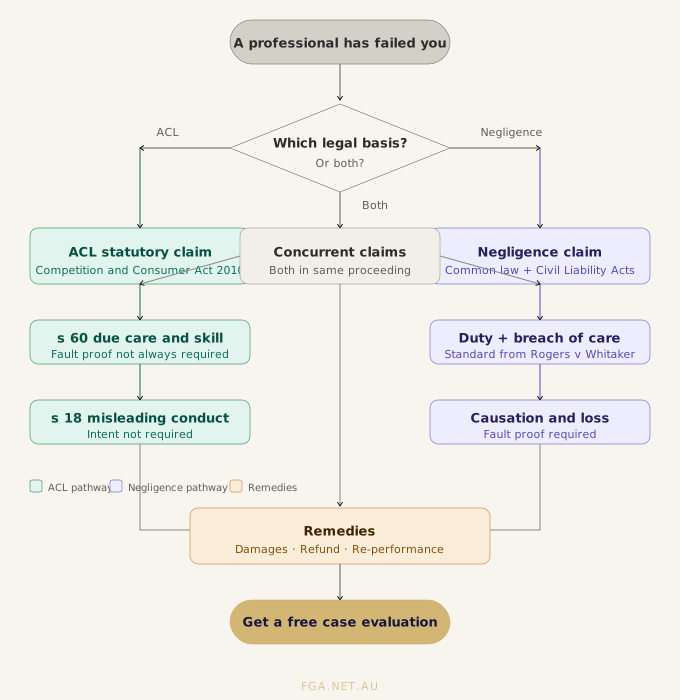
People often ask whether they should be bringing a negligence claim, an ACL claim, or both. The honest answer is that it depends on the facts — and a proper assessment requires legal advice specific to your situation. But it helps to understand how the two frameworks differ before that conversation happens.
A professional negligence claim is grounded in the common law and state legislation — the Civil Liability Acts that apply across Australian jurisdictions. To succeed, you need to establish that the professional owed you a duty of care, that they breached that duty by falling below the standard of a reasonably competent practitioner, that the breach caused your loss, and that the loss is quantifiable. Fault is central to the analysis.
An ACL claim based on a guarantee breach — particularly s 60 — is closer to a strict liability standard. If the services were not rendered with due care and skill, the guarantee is breached. The focus shifts from whether the professional was negligent in the traditional sense, to whether what they delivered actually met the statutory standard. For some claimants, that distinction matters.
At a glance — key differences:
Maximising your position
In many professional services disputes, claimants plead both causes of action in the same proceedings. There is nothing preventing this — Australian courts regularly hear ACL and negligence claims argued side by side, and doing so can strengthen the overall case in a number of ways.
First, if the ACL guarantee claim does not require proof of fault in the same way a negligence claim does, it can provide an alternative pathway to recovery if the negligence pleading faces difficulty on the standard of care element. Second, the misleading conduct provisions under s 18 open an avenue that simply does not exist in negligence law — allowing claims for representations that caused loss, even where the professional’s conduct did not fall below a measurable objective standard.
Third, the remedies available under the ACL — including orders for refund or re-performance of services, as well as damages for consequential loss — can complement a damages award under negligence rather than being in conflict with it.
Whether a concurrent pleading strategy is appropriate depends on the specific facts of your situation. It is not something to approach without specialist legal advice. But for claimants who have been harmed by a professional, the ACL is often an underused tool worth examining carefully.
What you can recover
When a consumer guarantee has been breached, the ACL provides a suite of remedies that go beyond simply getting your money back. Depending on the nature and severity of the breach, you may be entitled to:
Whether any particular remedy is available depends on the circumstances of the breach, the nature of the loss suffered, and the specific provisions engaged. The ACL does not guarantee a particular outcome — but it does create rights that exist independently of whatever the professional’s engagement agreement may say.
For misleading conduct claims under s 18, the primary remedy is compensatory damages — the amount needed to put you in the position you would have been in had the misleading conduct not occurred. In some cases, courts have also ordered injunctions and declarations.
Case law
Courts have grappled with the intersection of consumer law and professional services for decades. Two cases in particular shaped the legal landscape in ways that remain relevant today.
In Butcher v Lachlan Elder Realty Pty Ltd (2004) 218 CLR 592, the High Court considered misleading or deceptive conduct in a professional services context. The case turned on whether a real estate agent’s representations constituted conduct that was objectively misleading, and reinforced the principle that the test under what is now s 18 focuses on the effect of the conduct on a reasonable person in the position of the recipient — not on the intention of the professional who made the representation. That principle applies equally across professional services disciplines.
In Wardley Australia Ltd v Western Australia (1992) 175 CLR 514, the High Court addressed the question of when loss is suffered for limitation purposes in a misleading conduct claim. The court’s reasoning on the accrual of damage in negligence and statutory claims continues to inform how courts approach limitation questions in professional services disputes involving concurrent causes of action.
These are starting points rather than comprehensive guides. The application of the ACL to a specific professional services situation turns on the facts, the nature of the conduct, and the statutory provisions engaged.
If a professional has misled you, failed to deliver what was promised, or caused you real loss through their services, the Australian Consumer Law may give you additional rights that go beyond what negligence law provides. Understanding whether the ACL applies to your situation — and how it interacts with a potential negligence claim — is a question worth answering sooner rather than later.
Speak with our team for a free, confidential evaluation of your situation. We work on a no-win, no-fee basis, and there is no obligation to proceed.
We respond to all enquiries within 1 business day.
Common questions
Yes — solicitors who supply legal services in the course of a business are generally subject to the ACL’s consumer guarantees. If a solicitor’s services were not rendered with due care and skill, the guarantee in s 60 of the ACL may give you a basis for a claim in addition to common law professional negligence. The ACL’s prohibition on misleading or deceptive conduct under s 18 also applies to legal practitioners.
A professional negligence claim requires you to establish that the professional owed you a duty of care, fell below the standard of a reasonably competent practitioner, and that this caused your loss. An ACL guarantee claim — particularly under s 60 (due care and skill) — may not require the same degree of fault analysis. The statutory guarantee is breached if the services simply did not meet the required standard, regardless of whether the professional’s overall conduct was blameworthy in the negligence sense. The ACL also provides access to the misleading conduct provisions in s 18, which are not available under negligence law.
Yes. In professional services disputes, it is not uncommon for claimants to plead both causes of action in the same proceedings. Australian courts regularly consider ACL and negligence claims alongside each other. Whether a concurrent pleading strategy is appropriate for your situation depends on the specific facts and requires specialist legal advice. If you would like to understand which avenues apply to your circumstances, a free case evaluation is a sensible starting point.
Yes. The ACL is a federal law contained in Schedule 2 of the Competition and Consumer Act 2010 (Cth). It applies uniformly across all Australian states and territories. While it is administered jointly by the ACCC and state and territory fair trading offices, the substantive rights and guarantees it creates are identical regardless of where you are located.
ACL claims interact with state and territory limitation legislation, which means the time limit can vary depending on where you are and the nature of the claim. As a general guide, a limitation period of three to six years from the date loss is suffered — or in some cases from when the loss was discovered — tends to apply. If you are at all uncertain about whether time is still running in your situation, seek advice now. Missing a limitation deadline can permanently extinguish your right to claim, regardless of how strong the underlying case might be.
Our goal is to help people in the best way possible. this is a basic principle in every case and cause for success. contact us today for a free consultation.
Sign up to our newsletter